

Time:2025.12.03Browse:1
I. Core Working Principle
Thermal Printing Basics: Uses a heated printhead to generate text, barcodes, and QR codes on thermal paper—no ink required. Delivers tickets in <1 second, 3x faster than dot-matrix alternatives, critical for preventing traffic jams at entry/exit gates.
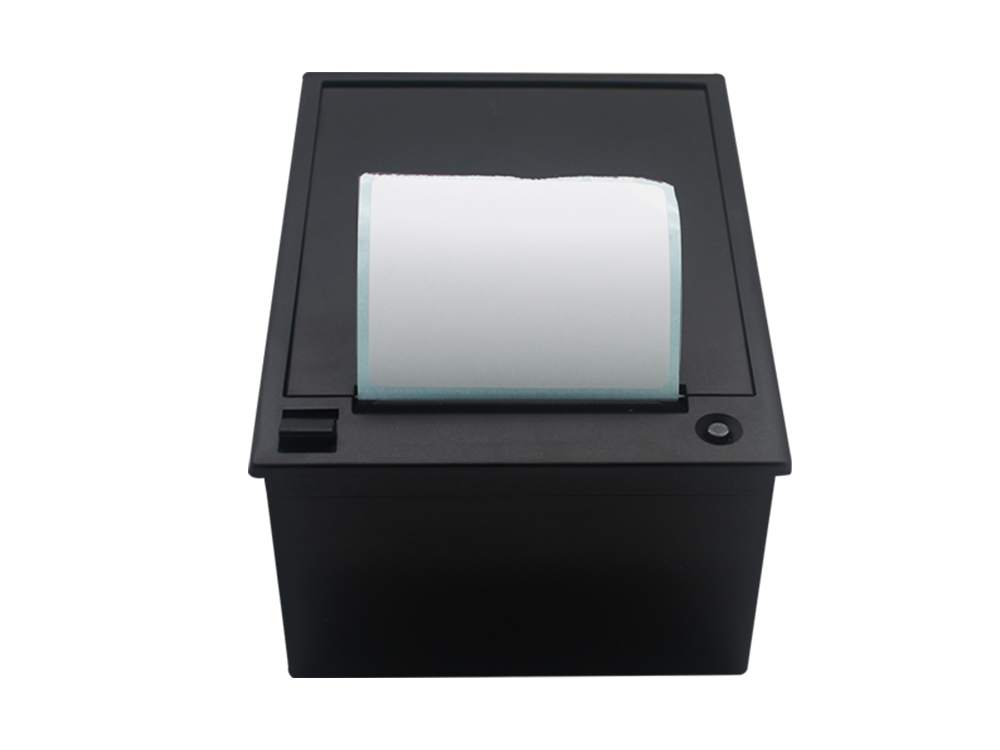
Embedded Front Panel Logic: Integrated into parking barriers or self-service kiosks, front-panel flip-top/slide-out designs enable tool-free paper replacement. One-hand operation minimizes maintenance time in unattended lots.
24V & Dual-Interface Integration: DC24V power directly matches parking barrier electrical systems (avoids extra adapters), while RS232/USB dual interfaces enable:
RS232: Long-distance (up to 15m) stable data transmission with LPR systems (resistant to electromagnetic interference from vehicles)
USB: Local debugging and quick connection to POS terminals for payment receipts
II. Key Features (24V & Dual-Interface Optimized)
1. Power & Interface Adaptability
DC24V Power Specifications:
Input range: 24V±10% (compatible with standard barrier gate power supplies), current 2-3.75A (supports 24/7 operation)
Energy efficiency: Standby power <1W (reduces operational costs for high-traffic lots)
RS232/USB Dual Interface:
RS232: Baud rate 2400-115200bps, DB9/DB25 connectors (anti-oxidation gold plating)
USB 2.0: Plug-and-play, 480Mbps transfer speed (enables 100-ticket batch printing in 30s)
Automatic interface switching: Prioritizes RS232 for LPR sync, switches to USB for local maintenance
2. Embedded & Easy-Load Design
Installation Compatibility:
Compact dimensions: 192×150×150mm (SPRT POS88III) to 214.5×134×147mm (Xinye 330B), fitting narrow gate cavities
Mounting: DIN rail or panel-mount options; front-panel flip-top opens 180° for tight spaces
Paper Handling:
Roll capacity: φ80-120mm (Xinye 330B supports φ120mm, reducing replacement frequency by 40%)
Smart sensors: Paper-low alert (triggers remote notification) and anti-jam reversal (downtime <5mins)
3. Performance for Traffic Efficiency
Speed & Clarity:
Printing speed: 101mm/s (Xinye 330B) to 220mm/s (Gprinter GP-80220II) — handles 300+ vehicles/hour
203DPI resolution: Ensures QR code scannability (success rate >99%) even with dust/rain smudges
Durability Metrics:
Printhead life: 100km (supports 500,000+ tickets/year)
Cutter life: 500,000-1,000,000 cuts (3+ years of 24/7 use)
4. Environmental Resilience
Operating Conditions:
Temperature: 5-45°C (Xinye 330B) to -20-60°C (industrial upgrades available)
Protection: IP42 minimum (dust-proof); IP54 optional (water-resistant for outdoor gates)
Material Durability:
Front panel: ABS plastic or aluminum alloy (resistant to vehicle exhaust corrosion)
III. Recommended 24V Dual-Interface Models
Xinye 330B (Mid-Range Workhorse):
Core Highlights: DC24V/2.5A, RS232+USB+Ethernet (triple interface), 127mm/s max speed, φ120mm paper capacity
Ideal For: Medium-traffic commercial lots (500-1,000 vehicles/day); supports pre-printed logos
Key Specs: 82mm print width, 100km printhead life, 256KB buffer
Gprinter GP-80220II (High-Speed Option):
Core Highlights: 220mm/s ultra-fast printing, DC24V/2.5A, RS232/USB/network interfaces, IP54 protection
Ideal For: Airport/mall parking (1,000+ vehicles/day); 全切 / 半切可调
Key Specs: 79.5mm print width, 128KB buffer, 19 international languages supported
SPRT POS88III (Cost-Effective Entry):
Core Highlights: DC24V/2A, RS232+USB (optional Ethernet), 150mm/s speed, easy-load front panel
Ideal For: Small lots (<500 vehicles/day); built-in overheat protection
Key Specs: 72mm print width, 500,000-cut cutter, φ80mm paper capacity
IV. Purchasing & Usage Guidelines
1. Selection Criteria
By Traffic Volume:
Low (<500 vehicles/day): SPRT POS88III (150mm/s, budget-friendly)
High (>1,000 vehicles/day): Gprinter GP-80220II (220mm/s, IP54)
By Integration Needs:
LPR + payment terminals: Xinye 330B (triple interface)
Outdoor gates: Gprinter GP-80220II (IP54)
By Power Compatibility:
Confirm barrier gate power: 24V±10% models avoid voltage converters (critical for industrial stability)
2. Installation & Maintenance Tips
Wiring Best Practices:
RS232 cable: Use shielded twisted pair (STP) for distances >5m (reduces interference from gate motors)
USB port: Install dust cover (prevents debris accumulation in outdoor environments)
Routine Care:
Monthly: Clean RS232/USB ports with compressed air; check 24V power connector for corrosion
Quarterly: Calibrate interface switching (ensure seamless LPR/USB transition)
3. Pitfall Avoidance
Interface Compatibility: Verify RS232 pinout (DB9 vs DB25) with your LPR system (e.g., Hikvision uses DB9)
Power Stability: Avoid daisy-chaining printers to gate motors (use separate 24V circuits to prevent voltage drops)
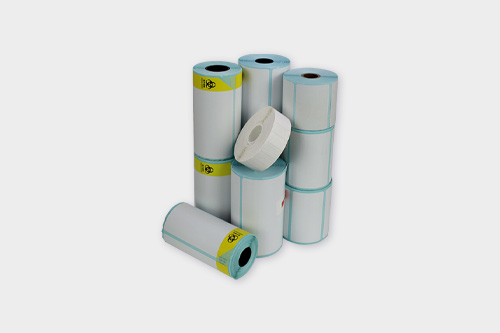
Paper Matching: Use 0.06-0.08mm thickness (compatible with all recommended models) — thinner paper causes jams
Read recommendations:





Building C, Bairongda, Ma'anshan, Bao'an District, Shenzhen City, Guangdong Province
Tel:18823301751
Service Hotline:400-008-8930

















 2025-08-13