

Time:2025.11.05Browse:1
I. Core Technical Parameters
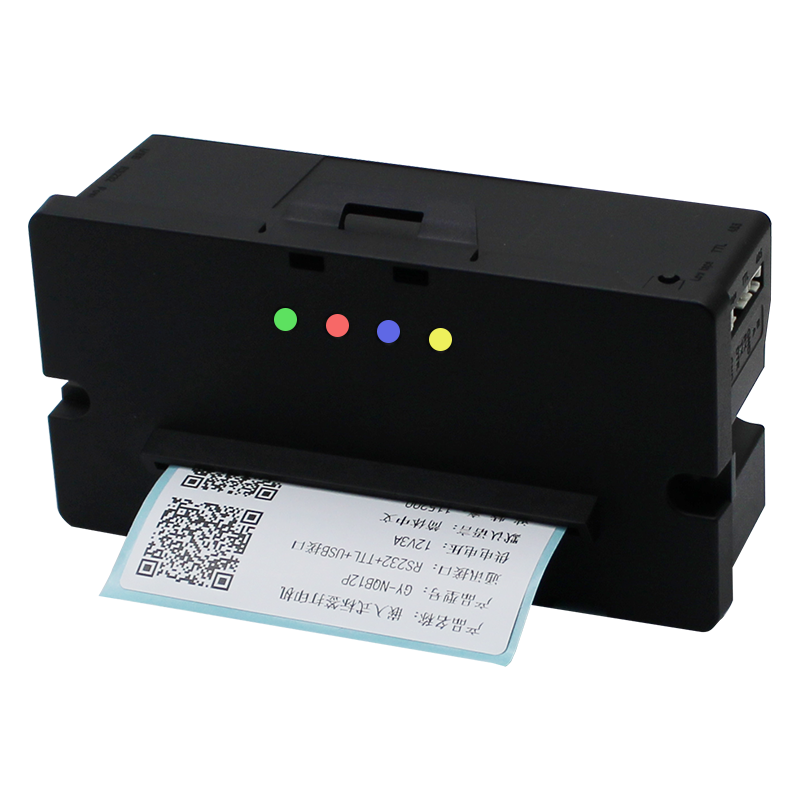
Printing Specifications: Print width corresponds to 2 inches (approximately 58mm), resolution is typically 203 DPI (some models support 300 DPI), printing speed is 2-6 inches/second (adjustable as needed).
Interface Characteristics: Standard RS232 serial interface, communication rate 1200-115200bps, supports hardware flow control (RTS/CTS), compatible with ASCII, GB2312 and other character encodings.
Installation Specifications: Panel mounting design, opening size is typically 70-85mm wide × 50-65mm high, body depth 50-100mm (must be matched according to the internal space of the device), some models support embedded clips or screw fixing.
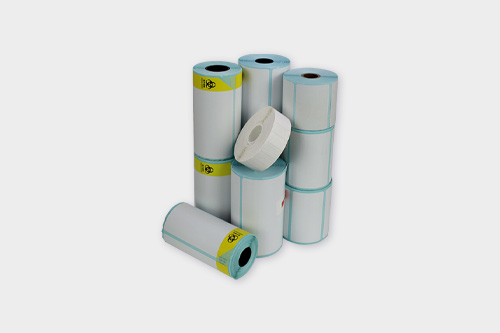
Consumables Requirements: Compatible with thermal paper rolls of 10-50mm diameter, paper thickness 50-80μm, supports black mark positioning (optional, for precise paper cutting or pagination).
Environmental Adaptability: Operating temperature 0-40℃ (industrial-grade models support -20-50℃), relative humidity 20%-80% (non-condensing), vibration resistance conforms to IEC 60068-2-6 standard.
II. Typical Application Scenarios
Industrial Control: Used for printing operation logs in PLC control systems and industrial machine tools. The RS232 interface allows for stable connection to industrial host systems and is adaptable to dusty and temperature-varying workshop environments.
Medical Equipment: Used with monitors, blood cell analyzers, etc., to print test reports. Must meet medical-grade electromagnetic compatibility (EMC) standards to ensure interference-free data transmission.
Self-Service Terminals: Embedded in self-service payment machines, ticket machines, etc., to print vouchers or receipts. The compact panel mounting design saves internal space.
Vehicle-Mounted Equipment: Used in logistics vehicle terminals and taxi meters to print freight bills or invoices. Must have wide operating temperature range and withstand vehicle vibrations.
III. Key Selection Considerations
Interface Compatibility: Confirm that the RS232 interface pin definitions (e.g., TX/RX/GND pin numbers) match the connected device, and that it supports both the required communication rate and flow control method.
Installation Compatibility: Measure the panel opening size and internal space of the device, and select a model with a matching body size to avoid installation difficulties due to insufficient depth or excessive width.
Printing Performance Matching: Determine the printing speed (e.g., for high-frequency printing, select a model with a speed of 4 inches/second or higher) and resolution (e.g., for barcode printing, select a 300 DPI model) based on the usage scenario.
Environmental Tolerance: For industrial or outdoor scenarios, prioritize models with wide temperature range and high shock resistance. For medical scenarios, confirm compliance with medical certifications (e.g., CE, MDD, FDA certification).
Consumable Compatibility: Select a suitable paper roll diameter based on daily printing volume. For high-frequency usage scenarios, it is recommended to select a model that supports large-diameter paper rolls to reduce paper change frequency.
Read recommendations:





Building C, Bairongda, Ma'anshan, Bao'an District, Shenzhen City, Guangdong Province
Tel:18823301751
Service Hotline:400-008-8930
















 2024-11-06